
How Much Solar Power Do I Need for My RV? Guide & Calculator
Table of contents
- Understanding RV Solar Power Basics
- Essential Components of an RV Solar System
- Step-by-Step Guide to Calculate Your RV Solar Needs
- Recommended Solar Setups for Different RV Types and Usage Scenarios
- Installation Options and Considerations
- Supplemental Power Sources for RV Solar Systems
- Real-World Considerations and Tips
- Conclusion
- Protect Your Solar-Powered RV Year-Round with Custom Skirting
- Related Articles
Are you wondering how much solar power do I need for my RV to enjoy true off-grid freedom? You’re not alone. As more RV enthusiasts embrace boondocking and dry camping, determining how many solar panels to power a camper has become a crucial question. Whether you’re a weekend warrior or full-time RVer, understanding how much solar for an RV you need can be the difference between a frustrating experience with dead batteries and the freedom to camp anywhere with reliable power. This comprehensive guide will walk you through calculating your specific requirements, explain the essential components of an RV solar system, and provide recommendations based on different usage scenarios.
Understanding RV Solar Power Basics
Before diving into calculations, it’s important to understand what solar power actually does in your RV. Solar panels don’t directly power your appliances (with a few exceptions) – they charge your batteries, which then supply power to your RV systems. This distinction is crucial for setting realistic expectations.
A properly sized solar system allows you to maintain your battery bank while off-grid, reducing or eliminating generator usage. However, certain high-draw appliances like air conditioners typically can’t run continuously on standard RV solar setups. Solar energy is collected by panels, regulated by a charge controller, stored in batteries, and then converted from DC to AC power (if needed) by an inverter.
The beauty of solar is its silent operation and renewable nature – once installed, the sun provides free energy. But determining how much solar power do I need for my RV requires understanding your specific power consumption patterns and expectations.
Essential Components of an RV Solar System
Solar Panels
Solar panels are the most visible part of your RV solar system and come in several varieties:
- Monocrystalline panels: Highest efficiency (20-22%), more expensive, perform better in partial shade
- Polycrystalline panels: Moderate efficiency (15-17%), more affordable, slightly larger footprint
- Flexible panels: Lightweight, can conform to curved surfaces, typically less efficient and shorter lifespan
When figuring out how many solar panels to power a camper, it’s important to understand how panel output is measured. Solar panel capacity is rated in watts, with common sizes being 100W, 200W, and 400W. Under ideal conditions, a 100W panel typically generates around 30 amp-hours per day (about 5–6 hours of peak sunlight). However, real-world factors like shading, panel orientation, and temperature can reduce actual energy production.
Panel placement also plays a big role in efficiency. Roof-mounted panels are convenient and low-maintenance, but they’re fixed in place. Portable ground panels, on the other hand, can be moved for optimal sun exposure. Many experienced RVers combine both options for maximum flexibility and consistent power generation while camping off-grid.
Solar Charge Controllers
Charge controllers regulate the voltage and current coming from solar panels to safely charge your batteries. There are two main types:
- PWM (Pulse Width Modulation): More affordable but less efficient (75-80%)
- MPPT (Maximum Power Point Tracking): More expensive but significantly more efficient (94-99%), especially in cooler temperatures or when panel voltage is much higher than battery voltage
Selecting the right controller size depends on your solar array’s total wattage and voltage. For a 12V battery system with 400W of solar, you’d need at least a 30A controller (400W ÷ 12V = 33.3A). Quality brands like Victron, Renogy, and Blue Sky are popular among RVers for their reliability and features.
Battery Banks
Batteries are the heart of your RV solar system, storing the energy your panels collect. The three main types used in RVs are:
- Flooded Lead-Acid: Affordable but require regular maintenance and can only be discharged to about 50%
- AGM (Absorbed Glass Mat): Maintenance-free, more expensive than flooded, also limited to about 50% discharge
- Lithium (LiFePO4): Most expensive upfront but longest lifespan, can be discharged to 80-90%, lightweight, and maintenance-free
Battery capacity is measured in amp-hours (Ah), which indicates how much current a battery can supply over time. For instance, a 100Ah battery can theoretically deliver 1 amp for 100 hours or 100 amps for 1 hour, although real-world performance varies due to discharge limits.
When figuring out how many solar panels to power a camper, it’s essential to understand your battery capacity and energy needs. While calculating how much solar power you need for your RV, keep in mind that most RVs have a constant parasitic draw from devices like propane detectors, stereos, and other always-on systems—typically between 0.5 and 2 amps. Factoring in this continuous drain helps ensure your solar setup can fully support your energy demands while camping off-grid.
Inverters
Inverters convert DC power from your batteries into AC power for household appliances. There are two main types:
- Modified Sine Wave: Less expensive but can cause issues with sensitive electronics and some appliances
- Pure Sine Wave: More expensive but provides clean power identical to shore power, compatible with all devices
Inverter sizing depends on the combined wattage of all AC appliances you plan to run simultaneously, plus a 50% buffer for surge requirements. For example, if your maximum simultaneous load is 1,000W, a 1,500W inverter would be appropriate.
Keep in mind that inverters are not 100% efficient (typically 85–95%) and draw a small amount of power even when idle (10–25W). These factors affect your total energy needs and should be considered when calculating how many solar panels to power a camper or determining your RV’s ideal solar setup.
Step-by-Step Guide to Calculate Your RV Solar Needs
Step 1: List All Your Power-Consuming Devices
The first step in determining how much solar power do I need for my RV is creating a comprehensive inventory of all electrical devices. Here’s a table of common RV appliances and their typical power consumption:
| Appliance | Watts | Typical Daily Usage | Watt-Hours/Day |
|---|---|---|---|
| Air Conditioner | 1,500-2,000W | 3-5 hours | 4,500-10,000Wh |
| Microwave | 1,000-1,500W | 15-30 minutes | 250-750Wh |
| Residential Refrigerator | 100-200W | 24 hours (40% duty cycle) | 960-1,920Wh |
| RV Refrigerator (electric) | 180W | 24 hours (40% duty cycle) | 1,728Wh |
| TV (LED) | 30-150W | 3-5 hours | 90-750Wh |
| Laptop | 45-90W | 2-4 hours | 90-360Wh |
| LED Lights (5 fixtures) | 25-50W total | 4-6 hours | 100-300Wh |
| Water Pump | 60-100W | 30 minutes | 30-50Wh |
| Furnace Fan | 8-10A (96-120W) | 2-8 hours (seasonal) | 192-960Wh |
| Coffee Maker | 600-1,200W | 20 minutes | 200-400Wh |
| Instant Pot | 700-1,000W | 30-60 minutes | 350-1,000Wh |
| CPAP Machine | 30-60W | 8 hours | 240-480Wh |
| Cell Phone Charger | 5-10W | 2-3 hours | 10-30Wh |
Always check the actual wattage ratings on your specific devices, as they can vary significantly from these estimates.
Step 2: Determine Daily Usage Patterns
Next, estimate how many hours per day each device will be used. This varies based on your camping style:
- Weekend Warriors: Typically use fewer appliances for shorter periods
- Seasonal Campers: Usage varies by season (more heating in winter, more cooling in summer)
- Full-Timers: Generally have higher and more consistent power needs
For each device, multiply its wattage by the hours of use to get watt-hours:
Watt-hours = Watts × Hours of Use
For devices that cycle on and off (like refrigerators), multiply by the duty cycle percentage. For example, a 180W refrigerator running at a 40% duty cycle for 24 hours:
180W × 24 hours × 0.4 = 1,728 watt-hours
Step 3: Calculate Total Daily Energy Consumption
Add up all the watt-hours from Step 2 to get your total daily energy consumption. Then convert this to amp-hours for a 12V system:
Amp-hours = Watt-hours ÷ 12V
For example, if your total daily consumption is 1,200 watt-hours:
1,200Wh ÷ 12V = 100Ah
When using AC appliances through an inverter, account for efficiency losses:
AC Watt-hours ÷ Inverter Efficiency = Actual Battery Drain (in watt-hours)
For a 1,000W microwave used for 30 minutes through an 85% efficient inverter:
1,000W × 0.5 hours = 500Wh
500Wh ÷ 0.85 = 588Wh actual battery drain
Step 4: Determine Battery Capacity Requirements
To calculate how much battery capacity you need, consider:
- Your daily energy consumption (in amp-hours)
- Desired days of autonomy (typically 1-3 days without recharging)
- Battery type and its usable capacity percentage
For lead-acid or AGM batteries (50% usable capacity):
Required Battery Capacity = Daily Amp-Hours × Days of Autonomy × 2
For lithium batteries (80% usable capacity):
Required Battery Capacity = Daily Amp-Hours × Days of Autonomy × 1.25
Example: If you use 100Ah daily and want 2 days of autonomy with AGM batteries:
100Ah × 2 days × 2 = 400Ah battery bank
With lithium batteries:
100Ah × 2 days × 1.25 = 250Ah battery bank
Step 5: Calculate Required Solar Panel Wattage
To determine how much solar power do I need for my RV, use this formula:
Required Solar Wattage = Daily Amp-Hours × Battery Voltage ÷ Available Sun Hours × Efficiency Factor
The efficiency factor accounts for system losses (typically 0.7 or 70%).
Available sun hours vary by location and season:
- Southwest US (summer): 5-7 hours
- Northern US (summer): 4-6 hours
- Most locations (winter): 2-4 hours
Example: For 100Ah daily consumption with 5 hours of sun:
100Ah × 12V ÷ 5 hours ÷ 0.7 = 343W of solar panels
A general guideline is 200-400 watts of solar per 100 amp-hours of battery capacity, depending on your location and season of use.
Recommended Solar Setups for Different RV Types and Usage Scenarios
Minimal Setup (200W): Weekend Campers
If you’re primarily a weekend camper who stays at campgrounds with hookups but occasionally dry camps, a minimal solar setup might be sufficient:
Components:
- 200W of solar panels (two 100W panels)
- 20A PWM charge controller
- 100-200Ah of AGM batteries or 50-100Ah of lithium
- 500-1,000W pure sine wave inverter
What it can power:
- LED lights throughout the RV
- Device charging (phones, tablets, laptops)
- TV/entertainment system for a few hours
- RV refrigerator on propane mode
- Water pump and furnace fan
What it cannot handle:
- Air conditioning
- Electric water heater
- Microwave or other high-draw appliances for extended periods
Approximate cost: $800-$1,500
This setup is perfect for those just dipping their toes into boondocking or who need to extend their stay at a non-hookup site for a day or two. It’s also a good starter system that can be expanded later as needs grow.
Standard Setup (400-700W): Regular Boondockers
For RVers who frequently camp off-grid for several days at a time, a more robust system is necessary:
Components:
- 400-700W of solar panels (combination of roof and portable)
- 40-60A MPPT charge controller
- 200-400Ah of AGM batteries or 100-200Ah of lithium
- 2,000W pure sine wave inverter
What it can power:
- All basic systems (lights, water pump, furnace)
- RV refrigerator (propane or electric mode)
- TV/entertainment system
- Laptops and device charging
- Small appliances (coffee maker, blender) for limited use
- Occasional use of microwave
What it cannot handle:
- Air conditioning for more than brief periods
- Multiple high-draw appliances simultaneously
- Electric water heating for extended periods
Approximate cost: $2,000-$4,000
This mid-range setup provides a good balance of power availability and cost. It allows for comfortable off-grid living with some energy management practices.
Power User Setup (800W+): Full-Time Off-Grid Living
Full-time RVers who spend extended periods off-grid need a comprehensive solar system:
Components:
- 800W+ of solar panels (often 1,000-1,500W)
- 60-100A MPPT charge controller
- 400-600Ah of lithium batteries
- 3,000W+ pure sine wave inverter with high surge capacity
What it can power:
- All RV systems simultaneously
- Residential refrigerator
- Entertainment systems
- Office equipment for remote work
- Most kitchen appliances
- Limited air conditioner use (depending on total system size)
What it cannot handle:
- Continuous air conditioner operation without supplemental power
- Electric space heaters for extended periods
Approximate cost: $5,000-$10,000+
This setup represents a significant investment but provides near-grid-like power independence. Many full-timers find this freedom well worth the cost, especially when considering the savings from free boondocking locations.
Installation Options and Considerations
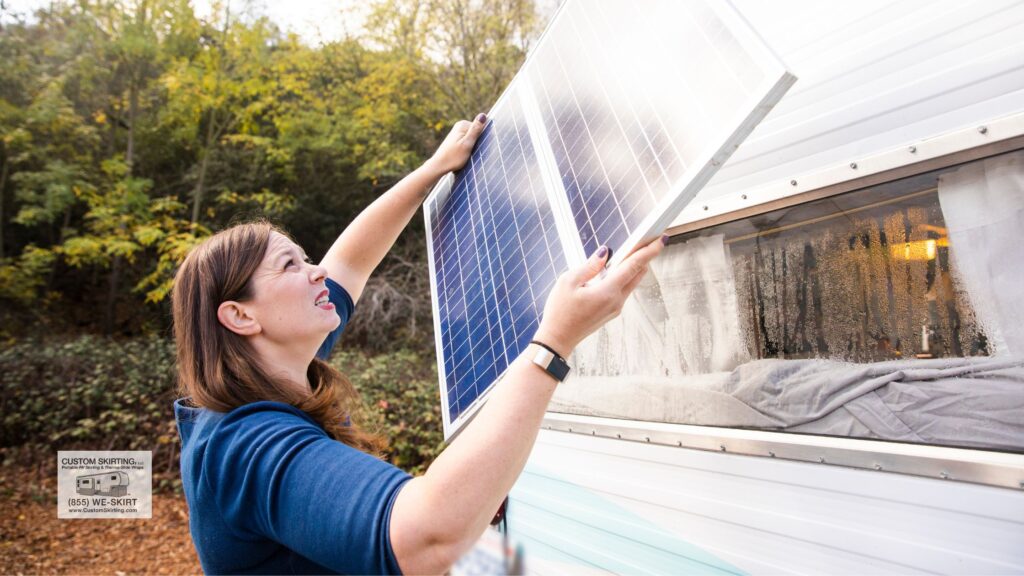
Roof-Mounted vs. Portable Solar Panels
When determining how much solar power do I need for my RV, also consider the installation method:
Roof-Mounted Panels:
- Advantages: Always ready to use, no setup required, secure from theft, no storage space needed
- Disadvantages: Fixed orientation limits efficiency, can’t be positioned to avoid shade, limited by roof space
Portable Panels:
- Advantages: Can be positioned for optimal sun exposure, can be moved throughout the day to track the sun, easy to add to existing systems
- Disadvantages: Require setup/breakdown, storage space needed, potential theft risk, cable management challenges
Many experienced RVers use a hybrid approach: roof panels provide baseline charging while portable panels add extra power when needed. Tilt mounts for roof panels can increase efficiency by 20-30% by allowing adjustment based on the sun’s seasonal position.
DIY vs. Professional Installation
Installing solar on your RV presents a choice between DIY and professional installation:
DIY Installation:
- Pros: Significant cost savings, educational experience, customization flexibility
- Cons: Risk of mistakes, potential warranty issues, time-consuming, requires technical knowledge
Professional Installation:
- Pros: Expert workmanship, warranty protection, time savings, proper system design
- Cons: Higher cost, potential scheduling delays, less control over component selection
If you’re wondering how many solar panels to power a camper, it’s best to start small and gain hands-on experience. Begin with portable ground panels before attempting a full roof installation. For roof-mounted systems, make sure to properly seal all mounting hardware to prevent leaks. Many RVers prefer a hybrid approach—getting the roof components professionally installed while handling the interior electrical work themselves.
Supplemental Power Sources for RV Solar Systems
Generators as Backup Power
Even with a well-designed solar system, generators remain valuable backup power sources when determining how much solar power do I need for my RV:
- Portable generators (2,000-3,500W) offer flexibility and can be stored outside
- Built-in generators (3,600-7,000W) provide more power but add weight and use RV fuel tanks
Generators excel at bulk charging batteries during periods of low solar production. A common strategy is to run a generator for 2-3 hours to recharge batteries to 80-90%, then let solar handle the remaining absorption and float charging stages.
Modern inverter generators are significantly quieter and more fuel-efficient than older models. A typical 2,200W inverter generator uses about 0.1-0.2 gallons of fuel per hour at low loads, making it an economical backup when solar input is insufficient.
Shore Power and Alternator Charging
A complete RV power system integrates multiple charging sources:
- Shore power through a converter/charger when at campgrounds
- Alternator charging while driving through a battery isolator or DC-DC charger
- Solar power as the primary off-grid source
Multi-stage chargers can automatically select the appropriate charging source based on availability. For frequent movers, alternator charging can contribute significantly to battery maintenance, reducing the need for large solar setups. However, for stationary RVers wondering how many solar panels to power a camper, a larger solar array becomes essential to keep the batteries charged and appliances running efficiently.
Many best deep cycle battery for your RV systems now include battery monitoring systems that track power input and output from all sources, helping you optimize your energy management strategy.
Real-World Considerations and Tips
Seasonal and Geographic Variations
When calculating how much solar power do I need for my RV, location and season dramatically affect solar production:
- Southwest US (summer): 5-7 hours of peak sun, high temperatures reduce panel efficiency
- Pacific Northwest (winter): 1-3 hours of peak sun, frequent cloud cover
- Southeast US: Humidity and afternoon thunderstorms can reduce efficiency
- Northeast/Midwest (winter): Snow cover can completely block panels
Seasonal travelers should size their system for the conditions where they’ll spend most time. Snowbirds who follow good weather may need less solar than those who stay in one region year-round.
For winter camping, tilt mounts become essential to shed snow and capture the lower-angle winter sun. Some RVers who live in an RV during the winter add up to 50% more solar capacity to compensate for reduced sun hours.
Future-Proofing Your Solar System
Solar technology continues to evolve rapidly, so consider these future-proofing strategies:
- Oversize wire runs – Using larger gauge wire than currently needed allows for system expansion
- Choose a charge controller with capacity for additional panels
- Install combiner boxes with extra capacity for future panel additions
- Select an inverter that exceeds current needs but matches future plans
- Design battery storage with expansion in mind (especially with lithium systems)
Many RVers start with a smaller system and add components as they learn their actual power needs. The best solar panels for RV use may change as technology advances, so designing for modularity allows for upgrades without complete system replacement.
Conclusion
Determining how much solar power you need for your RV depends on your specific power requirements, camping style, budget, and expectations. If you’re wondering how many solar panels to power a camper, the answer varies based on your energy usage and setup. By following the calculation process outlined in this guide, you can design a solar system that meets your unique needs rather than relying on one-size-fits-all recommendations.
Start by thoroughly assessing your power consumption, then build a system that can grow with your needs. Remember, solar is an investment in freedom and independence — the ability to camp where and how you want without worrying about power limitations.
Whether you need 200 watts for occasional weekend trips or 1,500 watts for full-time boondocking, understanding how many solar panels do I need for my RV will help you create the perfect off-grid setup. The right solar system will transform your RVing experience by providing clean, quiet, renewable energy wherever your adventures take you.
Protect Your Solar-Powered RV Year-Round with Custom Skirting
While your solar panels keep your RV powered, don’t forget about protecting your investment during colder months! Custom Skirting offers the nation’s #1 RV skirting solution that perfectly complements your solar setup. Our expert team blueprints and custom-tailors your RV skirting on-site, ensuring a flawless fit that provides unparalleled protection for your RV’s undercarriage and systems.
Our exclusive “No-Snap, No-Gap” channel system seals out water, snow, and wind more effectively than any other product on the market, helping maintain interior temperatures and reducing heating demands on your solar system. With over a decade of testing in the harshest winters across the northern United States and Canada, our skirting has proven itself as the top choice for RV enthusiasts who want to extend their camping season.
The best part? Our user-friendly design can be set up by just one person in about an hour and is ready to move with you whenever adventure calls. Get Custom Skirting today, and experience the perfect complement to your solar power system!